HEBA Fire & Safety in Saudi Arabia and what buyers should verify
What the search for heba fire and safety usually means
Searches for heba fire and safety usually refer to HEBA Fire & Safety Co. Ltd, a Saudi Arabia-based fire and safety company associated with firefighting equipment, fire trucks, safety equipment, and systems engineering. Public company information describes its work as the supply, design, installation, testing, commissioning, and maintenance of fire fighting, safety, and security systems.
For buyers, engineers, and facility managers, the key issue is not only identifying the company. It is verifying whether any supplier in this category can meet Saudi regulatory requirements, applicable product standards, project documentation needs, and long-term maintenance obligations. This article reviews the public information available about HEBA Fire & Safety and places it in the wider context of fire protection procurement in Saudi Arabia. It is intended for industrial plants, commercial buildings, warehouses, utilities, and project teams comparing fire and life safety suppliers. For related coverage, see the Safety Systems section.

Company profile based on public information
Publicly available company information identifies HEBA Fire & Safety Co. Ltd as a Dammam-based business in the fire and safety sector. The company’s own description says it specializes in the supply, installation, design, testing, commissioning, and maintenance of fire fighting, safety, and security systems. It also lists service areas that include fire fighting equipment, fire trucks, safety equipment, and systems engineering.
That is a broad service scope. In practice, a company operating in this field may support several stages of a project: product selection, design coordination, system installation, authority submissions, functional testing, commissioning records, and periodic inspection or maintenance. Each stage carries different risks. A compliant product can be poorly installed. A correctly installed system can become unreliable if it is not maintained. A maintenance report can exist but still fail to identify impairments that would matter during an emergency.
HEBA’s public information also says it provides portable, automatic, and wheeled fire extinguishers that meet requirements and standards of the Saudi Standards, Metrology and Quality Organization, commonly known as SASO, and the European Norm BS EN3. This is useful buyer-facing information, but it should be checked at the product level. Procurement teams should request model-specific certificates, approvals, test reports, manuals, warranty terms, and evidence that the supplied product matches the certified configuration.
Directory listings and public profiles also associate the company with Saudi Arabia and with fire fighting, safety, and security systems. Such listings can help confirm basic market presence, but they should not replace formal due diligence. In fire protection procurement, the decisive evidence is usually found in licenses, authority approvals, approved drawings, product certificates, commissioning documentation, and maintenance records.
Why Saudi fire protection procurement needs documented verification
Fire protection systems are life safety systems, not ordinary building accessories. Their value depends on correct design, installation, commissioning, inspection, and maintenance. Saudi Arabia’s regulatory environment reflects this. The Saudi Building Code framework includes fire prevention and protection requirements, and the Executive Regulations identify responsibilities related to monitoring the application of the code and controlling violations in construction, maintenance, operation, and storage.
Public Saudi Building Code update information lists the Saudi Fire Code, SBC 801, with a release date of September 23, 2018 and a last update date of March 22, 2023. This matters because fire protection designs should be checked against the edition and local authority requirements applicable to the project, rather than against generic assumptions or outdated specifications. A warehouse, hospital, industrial plant, school, parking structure, and high-rise building can each raise different issues for fire load, evacuation, alarm, suppression, and smoke control.
Saudi safety regulations also point to the role of the General Directorate of Civil Defense and to the need for technical reports or submissions by specialized safety and firefighting offices in relevant building categories. Where Saudi standards do not exist for a particular item or condition, regulations may refer to accepted international standards, including standards from the United States or European common market countries. For procurement teams, the practical lesson is clear: product brochures are not enough. Each product and system should be connected to the applicable Saudi requirement, international standard, project specification, and authority approval route.
For industrial buyers, documentation is especially important because site risks are often higher than in simple commercial occupancies. Chemical storage, fuel handling, hot work, process equipment, electrical rooms, high-bay storage, and remote utility areas can all change the protection strategy. A supplier’s ability to provide compliant equipment is important, but its ability to support drawings, calculations, installation quality, testing procedures, spare parts, and maintenance records may be just as important.
Key systems and equipment to review before purchase
A supplier described as active in fire fighting equipment, safety equipment, fire trucks, and systems engineering may cover several different categories. Buyers should review those categories separately instead of treating fire safety as a single purchase package. The following areas are commonly relevant in commercial and industrial projects.
Portable and wheeled fire extinguishers
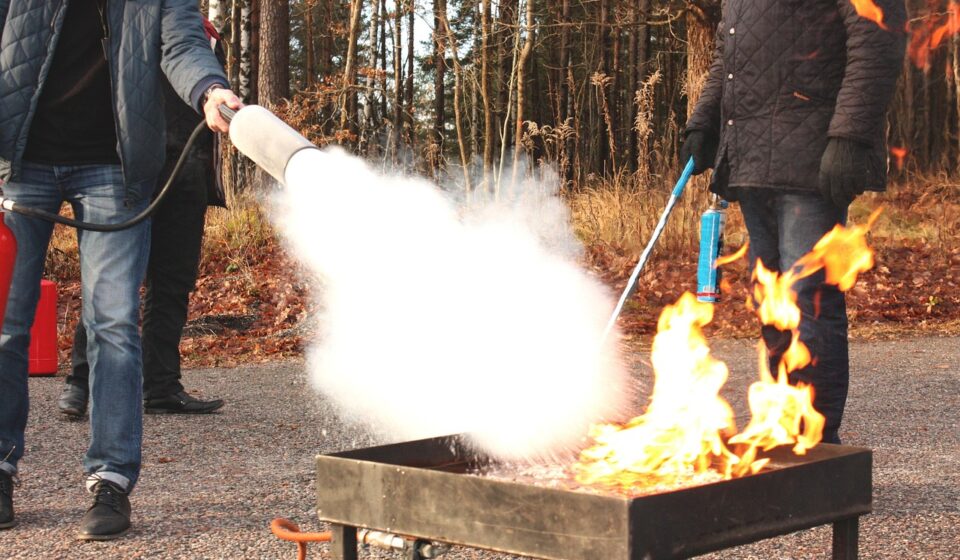
Extinguishers are often the most visible fire safety items, but they are also easy to underspecify. The public HEBA company profile refers to portable, automatic, and wheeled extinguishers and mentions SASO and BS EN3 requirements. Buyers should verify the extinguishing agent, fire rating, operating temperature, cylinder approval, pressure test requirements, spare parts availability, and labeling language. They should also check whether the extinguisher type suits the actual hazard, such as ordinary combustibles, flammable liquids, electrical equipment, or cooking oils.
Fire hose cabinets and hose reels
Fire hose cabinets, hose reels, landing valves, and related accessories should be selected with the building layout, pressure conditions, corrosion exposure, and local authority expectations in mind. In coastal or industrial environments, enclosure material, valve quality, cabinet sealing, drainage, and maintenance access can affect service life. A cabinet that looks acceptable at handover can become difficult to operate if corrosion, leakage, missing nozzles, or blocked access is not controlled.
Automatic sprinkler and water-based systems
Water-based fire protection systems require coordination with pumps, tanks, piping, valves, alarms, flow switches, drains, hydraulic calculations, and test connections. NFPA 25 is widely recognized as a standard for inspection, testing, and maintenance of water-based fire protection systems. Even where local requirements control the project, recognized inspection and maintenance concepts help facility teams ask better questions about valve status, fire pump tests, water supply, system impairments, and recordkeeping.
Fire alarm and detection systems
Detection and alarm systems are only effective when devices, panels, notification appliances, interfaces, batteries, cause-and-effect programming, and maintenance procedures work together. NFPA 72 is widely recognized for fire alarm and signaling systems, including application, installation, inspection, testing, and maintenance. For buyers, the practical issue is integration: alarms may need to interface with elevators, smoke control, gas systems, pumps, access control, shutdown circuits, or building management systems.
Fire trucks and emergency response equipment
Where fire trucks or mobile emergency equipment are part of the scope, the evaluation becomes more complex. Capacity, pump performance, foam compatibility, hose storage, monitor reach, chassis support, crew safety, spare parts, and operator training can all affect operational readiness. Buyers should request technical data, acceptance test procedures, maintenance requirements, and after-sales support details before committing to a purchase.
A practical buyer checklist for HEBA Fire & Safety or any comparable supplier
The safest way to evaluate a fire protection supplier is to move from general reputation to verifiable evidence. The following checklist can be used when considering HEBA Fire & Safety or any comparable fire and safety supplier in Saudi Arabia. See also: Storage Systems.
| Area to verify | What to request | Why it matters |
|---|---|---|
| Company authorization | Trade registration, relevant licenses, Civil Defense-related approvals where applicable, and scope of authorized work | Confirms whether the company can legally perform the work required for the project |
| Product compliance | SASO, EN, UL, FM, ISO, or other applicable certificates tied to exact models | Prevents substitution with non-matching or uncertified products |
| Design capability | Approved drawings, hydraulic calculations, cause-and-effect matrices, equipment schedules, and design basis documents | Shows whether the supplier can support engineering review and authority approval |
| Installation quality | Method statements, inspection and test plans, material submittals, and site inspection records | Reduces the risk of hidden defects after handover |
| Commissioning | Functional test reports, pump test results, alarm test records, pressure tests, and deficiency lists | Demonstrates whether the installed system performs as intended |
| Maintenance support | Inspection schedule, spare parts plan, service response terms, technician qualifications, and reporting format | Keeps life safety systems reliable after the project is complete |
This checklist also helps avoid a common procurement mistake: comparing suppliers only by price. A lower quotation can become more expensive if it excludes testing, documentation, authority coordination, spare parts, or post-handover service. A higher quotation, in turn, should explain exactly what additional value is included.
How to read standards and supplier claims carefully
Fire safety marketing often uses phrases such as approved, compliant, international standard, high quality, or complete solution. These phrases are not automatically wrong, but they need context. A product may be manufactured to a standard, tested to a standard, listed by a certification body, accepted by an authority, or simply described by the seller as compliant. These are different levels of evidence.
For example, a claim that a fire extinguisher meets EN3 should be supported by documentation for the actual model and capacity being supplied. A claim that equipment meets SASO requirements should be connected to the relevant technical regulation, conformity documentation, and import or market requirements. A claim that a contractor can install and maintain systems should be supported by personnel qualifications, previous approved work, method statements, and project-specific approvals.
Buyers should also distinguish between design standards and maintenance standards. A sprinkler system may be designed under one set of rules and maintained under another recognized inspection framework. A fire alarm system may be approved at handover but later compromised by device changes, disabled interfaces, weak batteries, unrecorded faults, or construction modifications. Long-term compliance is therefore an operational discipline, not just a handover certificate.
System integration is another area that needs attention. Fire pumps, sprinklers, extinguishers, alarms, smoke control, emergency lighting, signage, fire doors, dampers, gas suppression, and emergency response plans are often handled by different parties. A supplier may be responsible for only one part of that chain. Project teams should define interface responsibility in writing, especially where signals, shutdowns, pressure monitoring, or emergency power are involved.
What this means for industrial and chemical facilities
For a chemical equipment or industrial audience, the evaluation bar should be higher than for a basic office fit-out. Industrial facilities may include combustible dust, flammable liquids, corrosive atmospheres, pressure systems, confined spaces, high-voltage rooms, loading areas, and process hazards that require specialized analysis. Standard off-the-shelf equipment may be necessary, but it may not be sufficient.
In these environments, fire protection decisions should be linked to process safety, hazardous area classification, material safety data, emergency response planning, and maintenance access. Foam systems, gas detection, clean-agent suppression, deluge systems, explosion relief, intrinsically safe devices, corrosion-resistant cabinets, and specialized PPE may be relevant depending on the process. No supplier name alone can determine the correct solution.
Facility owners should involve competent fire protection engineers and the authority having jurisdiction early in the project. Supplier discussions should begin after the hazard basis is clear, not before. The procurement package should define design codes, acceptance tests, documentation requirements, training, spare parts, and maintenance responsibilities. This approach protects the owner, the contractor, and the eventual occupants or operators of the facility.
For readers comparing suppliers, the practical takeaway is simple: treat HEBA Fire & Safety as one market name to evaluate within a structured technical process. Public information indicates a broad fire and safety scope, but project suitability depends on evidence for the specific system, building, hazard, and regulatory approval path.
Frequently asked questions
Is HEBA Fire & Safety a Saudi company?
Public company information and directory listings identify HEBA Fire & Safety Co. Ltd with Saudi Arabia, including contact details associated with Dammam. Buyers should still verify current registration, licensing, and authority-related approvals directly during procurement.
What services does HEBA Fire & Safety publicly describe?
Public descriptions refer to the supply, design, installation, testing, commissioning, and maintenance of fire fighting, safety, and security systems. Listed service areas include fire fighting equipment, fire trucks, safety equipment, and systems engineering.
Does a supplier claim of SASO or EN3 compliance prove suitability?
No. It is a useful starting point, but it should be verified with model-specific documentation and checked against the project’s hazard, building code, Civil Defense requirements, and operating conditions.
What is the most important document to request from a fire protection supplier?
There is no single document that proves everything. Buyers should request a complete package: product certificates, approved drawings, calculations, inspection and test plans, commissioning records, operation manuals, warranty terms, and maintenance schedules.
Why should maintenance be considered during procurement?
Fire protection systems must remain ready after handover. If spare parts, inspection access, technician capability, test procedures, and reporting formats are not planned during procurement, the owner may face reliability and compliance problems later.